The CJ3A Page CJ3B.info

Post reply

Warning: this topic has not been posted in for at least 120 days.
Unless you're sure you want to reply, please consider starting a new topic.

Note: this post will not display until it's been approved by a moderator.

Name:
Email:
Subject:
Message icon:

Verification:
Type the letters shown in the picture
Listen to the letters / Request another image

Type the letters shown in the picture:
Write the word between words Jeep from this JeepWILLYSJeep?:
How many slot has a GPW grill?  7 - 9 - 11:

shortcuts: hit alt+s to submit/post or alt+p to preview


Topic Summary

Posted by: Frank
« on: October 23, 2011, 03:34:15 PM »

Okay,

I was wondering what this core axle would be good for,
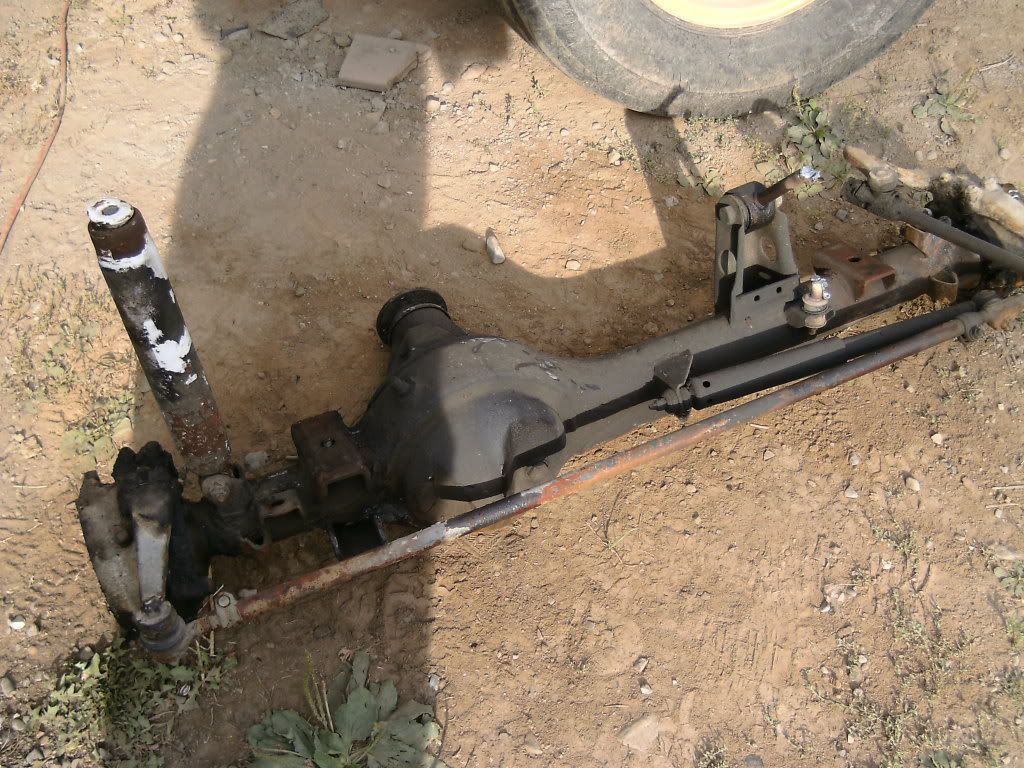


When I have time I will get this cleaned up and set up and start playing around with king pin bearing pre load, It would seem that with such a large spread in pre load, it should be narrowed down,

The reason I think 16 lbs of pre load is a bit to much is the happiest trunnion bearings I have seen the knuckle had very little pre load, and reading up on bearing pre load they tell me it is exacting,
I dont think anyone would argue the fact that a 3- 16lb range is not exacting, as mentioned earlier a excess pre load adds to the potential of brinnelling,
Now there is no difference in the bearings of the older axles vrs this newer one, None, same exact thing, �Jeep or Toyota, Timken or Toyo yoyo,

However in the most recent design of the axle of this type, they went with altogether the wrong bearing, entirely the wrong thrust angle for this application,


This bearing with the steeper thrust angle is correct, easy to see,


Now the greatest bearing pre load that I ever seen or worked with is .008 in a transmission with a aluminum case, this tight pre load is ( I think) required because the aluminum will expand quicker and more then the steel,

When setting the shafts up this tight you cannot turn them by hand, very tight, So What I want to do is get a idea between actual thickness of pre load and lb of pull,
Posted by: Frank
« on: October 20, 2011, 06:03:50 PM »

Quote
Quote
"Of course there is a lot of leeway in these axles so it probably won't matter much either way."

Yes Bob, These axles could be taken apart and repaired in the middle of nowhere with a hammer Rock and a screw driver, and maybee a set of vise grips, in a mud puddle,

Filled with just about anything that resembles a lubricant and get you where you need to go,

They also can be carefully cleaned and set up with new components , knuckle housings centered, pre load set, �filled with a correct lubricant, and get you where you need to go for 30 plus years without ever messing with it,


The question is how much improvement is there going to be when you center the knuckle housing over the factory method....will it be noticeable, all other things equal? After all ...when you turn the wheels, the knuckle is no longer aligned perfectly and the joint takes care of it. What is .010 misalignment up and down compared to the misalignment from driving around a corner? Preload is important, yes.

We all want our jeeps to last. Sometimes we have different methods. Sometimes we agree with the book, other times a better way has been found over the years. In any case, we are aiming for the same goal,keeping these fun little beasts running for another day in the woods. Life is too short to waste on name calling, endless arguing, and constant harangueing over pet peeves. If it keeps up I will have to put on my moderator hat, and ya don't want that, do ya?? :o

No need for the mod hat,
I will be good, Now your turning the wheel taking things out of alignment, No the axle is still straight, and yes the joint allows it to transfer power @ a angle, but is still straight

These U joints and cv joints can handle one load, only, and one angle,

In my process of researching this subject I read up on "Thompson Couplings" these could handle both, axial and lateral,

With only one joint in the shaft like these axles only one angle , (steering), if you had 2 joints in the power transfer shaft, then okay, �I discovered this trying to run a hydralic pump off only one u joint, could not make the shaft true enough , needed 2

Also Bill,

"The question is how much improvement is there going to be when you center the knuckle housing over the factory method.."

What I am trying to point out is that what is written in the book is not the factory method, not @ all, There is no way that Old Man Willies would have had Rosie the Riveter fiddling around with taking shims on and off, dialing in the knuckle,

Waste of time, Some sort of tool or fixture installed in the housing, lower gap measured and proper selective shim installed,

Also simply installing all the thickness of shims and then taking them out to set pre load, only and no thought to centering, No I really dont think so,

What really sells if for me is years later the world renowned Japanese machinists, centered up this axle housing very much the same way with selective shims, a very critical aspect in the replicated axle because of the location of the axle seal, off just a fuzz there and the seal leaks,

These shims take up machining irregularitys, By following the book word for word, basically states that Old man Willys had the knuckle perfectly centered something the Japanese could not do some 10 years later,

Maybee,


Preload is important, yes.

"Also, in case the main purpose is to prevent false
brinelling, the exact amount of preload needs be
calculated just enough to prohibit the creation of
clearance by vibration load, so as to prevent rolling
element from being vibrated by outside vibration
when shaft is not rotating."

And Yes bearing preloading is a rather exacting, in my humble opinion the ranges given in the books are rather broad, not exacting @ all,
Posted by: F Bill
« on: October 20, 2011, 03:41:20 PM »

Quote
"Of course there is a lot of leeway in these axles so it probably won't matter much either way."

Yes Bob, These axles could be taken apart and repaired in the middle of nowhere with a hammer Rock and a screw driver, and maybee a set of vise grips, in a mud puddle,

Filled with just about anything that resembles a lubricant and get you where you need to go,

They also can be carefully cleaned and set up with new components , knuckle housings centered, pre load set, �filled with a correct lubricant, and get you where you need to go for 30 plus years without ever messing with it,


The question is how much improvement is there going to be when you center the knuckle housing over the factory method....will it be noticeable, all other things equal? After all ...when you turn the wheels, the knuckle is no longer aligned perfectly and the joint takes care of it. What is .010 misalignment up and down compared to the misalignment from driving around a corner? Preload is important, yes.

We all want our jeeps to last. Sometimes we have different methods. Sometimes we agree with the book, other times a better way has been found over the years. In any case, we are aiming for the same goal,keeping these fun little beasts running for another day in the woods. Life is too short to waste on name calling, endless arguing, and constant harangueing over pet peeves. If it keeps up I will have to put on my moderator hat, and ya don't want that, do ya?? :o
Posted by: Frank
« on: October 20, 2011, 12:37:46 PM »

"Of course there is a lot of leeway in these axles so it probably won't matter much either way."

Yes Bob, These axles could be taken apart and repaired in the middle of nowhere with a hammer Rock and a screw driver, and maybee a set of vise grips, in a mud puddle,

Filled with just about anything that resembles a lubricant and get you where you need to go,

They also can be carefully cleaned and set up with new components , knuckle housings centered, pre load set,  filled with a correct lubricant, and get you where you need to go for 30 plus years without ever messing with it,


Posted by: Frank
« on: October 20, 2011, 12:16:51 PM »

Quote
So obviously the last sentence of paragraph #4 of the Willys manual is wrong, according to Frank.


Ventport, These old books are the best written well worded manuals that for the most part are very accurate, one this subject however there are a couple things that following the letter of the law if you will that dont really add up,

Now that book quoted for instance has a lighter pre load listed, 3-5 lbs, Which is what I like to lean towards on setting up these axles, rather then the tighter 12-16 or 18 ?

That is a good example, 10 lbs is quite a bit more squeeze, essentially loading the bearing before it even sets down on the ground, and you wonder why the bearings brinnell, theres your pressure, and vibration well just not pay any attention to the centering of the axle, theres your vibration,

What I will do next axle I work on is try to get a comparison between the weight of the pull per .001 of pre load, I am thinking that .002 preload on this bearing would be just fine, and see what that relates to pull,

I have also seen a spec of 80 inch lbs spec pull @ the trunnion stud,

No I follow the books to a point , but sometimes and in some cases its not always 100 % accurate, Its just the nature of the subject, there is sometimes a disconnect between the writers and the engineering ,

Now the original question was if the shims on the bottom trunnion cap where there because of some one who may have not known what they are doing, well at this point if they add up to a selective number that centers the housing,
They did, and leave them the same. and adjust the preload from the top, 3-5 or up to over 15, depending on what book you want to follow,
Posted by: ventport
« on: October 20, 2011, 09:55:16 AM »

So obviously the last sentence of paragraph #4 of the Willys manual is wrong, according to Frank.
Posted by: Frank
« on: October 19, 2011, 05:45:41 PM »

Quote
Frank, You really need to take a step back and think about what you are saying.

For everyone else, just use the appropriate Willys service manual for your vehicle and you will be fine. On pre-1951 Jeeps the front knuckle will be centered on the axle when the shims are equally divided between the top and bottom. Unequal shimming will cause the knuckle to move one way or the other slightly. Of course there is a lot of leeway in these axles so it probably won't matter much either way.

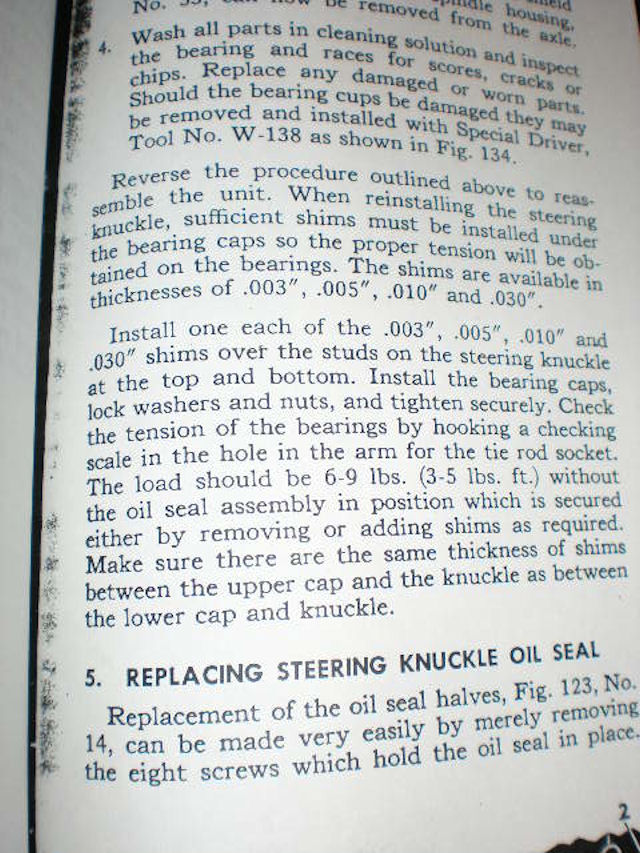
Here is a cut from a 1950 Willys service manual.


Likewise Bob, So dont worry about the shims, lots of leeway in the axle, run the axle croooked,

3-5 lbs pre load, and some books up to 18 lbs ???

Quite a spread really, So I am going to attempt to explain one more time Bob, Take just the bottom trunnion cap and bearing and stick it in the race on the axle housing,

The flat part of the trunnion cap is the bottom of the knuckle, start adding shims, little building blocks if you will, this will raise the knuckle housing,

Bob, there is quite a bit of thought going in to what I am saying, your just reading a book, not understanding what is happening here,

The lower shims, the little building blocks set the height of the knuckle housing, center it as best as possible,
Posted by: Bob W
« on: October 19, 2011, 01:03:39 PM »

Frank, You really need to take a step back and think about what you are saying.

For everyone else, just use the appropriate Willys service manual for your vehicle and you will be fine. On pre-1951 Jeeps the front knuckle will be centered on the axle when the shims are equally divided between the top and bottom. Unequal shimming will cause the knuckle to move one way or the other slightly. Of course there is a lot of leeway in these axles so it probably won't matter much either way.

Here is a cut from a 1950 Willys service manual.


Posted by: Frank
« on: October 19, 2011, 12:20:41 PM »

Quote
Why would the knuckle only move off center by changing the lower shim and not the upper shim? What is the difference?


Bob, May bee this would be easier to picture if you think of the vehicle sitting on the ground , the weight of the vehicle on the axle, the lower is set, not going to change, whatever that is,

The lower shims center the knuckle, you can take away shims from the top to add the pre load,


Or If you think of it like this, to move the knuckle housing up by changing just a upper shim, you would have to take away the same amount from the bottom,
Posted by: Frank
« on: October 19, 2011, 11:59:59 AM »

Quote
Why would the knuckle only move off center by changing the lower shim and not the upper shim? What is the difference?

Bob You must not be reading this,

Yep, by .010,
 
The lower shims Center the knuckle, adding a .010 would send it the other way, by .010, I really dont understand how this could even be a question, you take out the .010 shim, tighten up the trunnion cap bolts and it sucks it down that .010 that you removed,
 
Are you just messing with me ? the trunnion Stud pin, whatever you want to call it bottoms out against the bearing inner race and down comes the knuckle, by .010
 

Let me try this again,


Now with the knuckle centered , the lower trunnion cap will only go up so far, till is stops against the bearing, then there is that gap there, of which you select a shim that thick, it takes up that space,

Now if I where to not install that shim, or take .010 off of it, It would draw the knuckle housing down that far, when you tighten the bolts, Off centering the knuckle housing,

This rather easy for me to picture, but must be hard to explain,
Posted by: Bob W
« on: October 18, 2011, 06:39:38 PM »

Why would the knuckle only move off center by changing the lower shim and not the upper shim? What is the difference?
Posted by: Frank
« on: October 18, 2011, 05:52:45 PM »

Perhaps this picture will help,

With the centering tool installed and the spindle flipped around backwards the knuckle is centered with the axle, inserting the lower trunnion cap as far as it will go there is that .040 gap, of which the shim takes up,

Take .010 �away from that shim �then when the bolts are torqued it will pull the housing down, .010 off centering it by, .010

A alignment tool like this here, slides into the axle housing, slotted to expand , and machined out to the ID on the spindle, and since there is a machined ridge on both sides of this spindle, the knuckle is centered to the housing,

and wouldnt you know it after fiddling around with building and having this center tool made, the shim on the bottom was just right, re used it, but if I would take .010 off of it,

It would not fill that .040 gap and Down would come the knuckle,
Posted by: Frank
« on: October 18, 2011, 05:40:19 PM »

Quote
Quote
No ....

So with the same initial setup, if we remove 0.010" from the lower cap only, will the knuckle move off center?

Yep, by .010,

The lower shims Center the knuckle, adding a .010 would send it the other way, by .010, I really dont understand how this could even be a question, you take out the .010 shim, tighten up the trunnion cap bolts and it sucks it down that .010 that you removed,

Are you just messing with me ? the trunnion Stud pin, whatever you want to call it bottoms out against the bearing inner race and down comes the knuckle, by .010

Same thing on the top when you removed the .010 to snug up the preload a bit more, the pin squeezes into the bearing adding the additional desired "Squeeze"

Squeezing AKA bearing pre load,

Do not just split up shims evenly, the bottom center the knuckle, adj the "Squeeze" from the top,
Posted by: Bob W
« on: October 18, 2011, 01:49:36 PM »

Quote
No ....

So with the same initial setup, if we remove 0.010" from the lower cap only, will the knuckle move off center?
Posted by: Frank
« on: October 18, 2011, 01:21:19 PM »

Quote
Frank,

Please answer the following question with a yes or no.

Let's say we are setting up king pin bearings a Willys front axle. The knuckle is perfectly centered to the axle and there is preload on the king pin bearings. We have determined more preload is needed to meet the turning torque specification. Removing 0.010" of shim from the upper cap gives us the proper preload. By removing 0.010 of shims from the top only, did the knuckle move off center?


No Bob,

What I have been saying all along, without some sort of alignment tool, leave the lower shims the same, and adj pre-load from the Top,  This for sure is not fool proof if they had been lost track of in a prior service, but when working with a axle that has functioned well for years, leave them the same,

Now this is not as critical for these Dana axles, the axle seal position in the housing allows for more of a margin of error, but still you dont want the axle in out of whack, and housing off center,